Introducing the Flourishing Profile
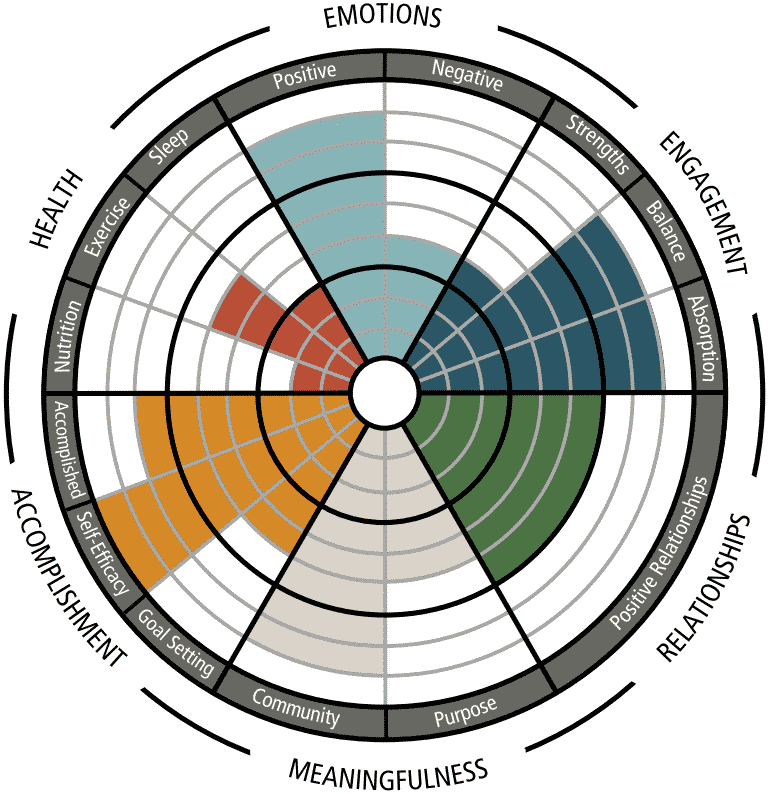
Rather than seeking to identify those who are distressed, or “at risk”, the Student Flourishing Survey (SFS) uses a positive psychology approach to assess the degree to which individuals have developed the “pillars” of good mental health to stay well and optimise quality of life. The SFS survey is a leading indicator of mental health, useful for proactive wellbeing interventions at both an individual and collective level. The approach is consistent with the Geelong Grammar School Model for Positive Education (2013).
The SFS was refined and validated in an Australian university study (Murdoch University) involving 15 schools and more than 7,500 students. More information about the reliability and validity of the survey can be found in the assessment manual. The online survey enables objective assessment of the success of wellbeing interventions and can also be used to benchmark wellbeing against normative samples. It is suitable for secondary students (ages 11-18+) and staff of all ages.
Administrator Dashboard
Administrators can review aggregate and individual student survey results
Apply custom filters to view aggregate data of specific groups (e.g. cohort/form class/advisor group)
Compare student wellbeing results against normative data (age and/or sex)
Provide teacher permissions to allow staff to review aggregate and/or individual student survey results and wellbeing goals (when the staff member has a FlourishDx account)
Survey Assessment Manual and Example Reports
What Questions are in the Survey?
The Student Flourishing Survey asks students to respond to questions to assess the degree to which they have established pillars likely to maintain and optimise wellbeing (physical and mental). The 14 survey scales are listed below with an example question for each.
| Survey Scales | Example Questions | |||
|---|---|---|---|---|
| Positive Emotions | Positive Emotions | The extent certain positive emotions were experienced during the previous week (e.g. Gratitude – an attitude of appreciation where you acknowledge some benefit you have received). | ||
| Negative Emotions | Negative Emotions | The extent certain negative emotions were experienced during the previous week (e.g. Nervous – high-strung or jumpy, or feeling uneasy). | ||
| Strengths Known | Strengths Known | Awareness of individual strengths and gifting (e.g. I know my strengths well). | ||
| Balance | Balance | The frequency of activities performed in the previous week that had were appropriately challenging for the individual’s skill level (e.g. What I had to do matched my skills well). | ||
| Absorption | Absorption | The frequency of activities performed in the previous week that completely absorbed the individual’s attention (e.g. Time passed faster than I thought it did during the activity). | ||
| Positive Relationships | Positive Relationships | Having relationships with family and friends that are enjoyable and based on mutual trust (e.g. My friends and I trust each other). | ||
| Purpose | Purpose | Having a sense of direction in life (e.g. I have a sense of direction in my life). | ||
| Community | Community | Belief in one’s ability to have a positive impact on others (e.g. I see how I can make a difference in other people’s lives). | ||
| Goal Setting | Goal Setting | Frequently working towards specific, measurable and realistic goals (e.g. I work towards the goals I set myself). | ||
| Self-Efficacy | Self-Efficacy | Belief in own ability be successful in pursuits despite challenge and adversity (e.g. I am confident to go after challenging goals). | ||
| Accomplished | Accomplished | Satisfaction that comes from the accomplishment of meaningful goals (e.g. I do specific things regularly that give me a sense of accomplishment). | ||
| Nutrition | Nutrition | Regular consumption of healthy food and beverages (e.g. About how many serves of vegetables do you eat each day? (1 serve = ½ cup or the size of a computer mouse)). | ||
| Exercise | Exercise | Regular amount of aerobic, resistance and incidental exercise performed (e.g. About how often do you engage in high intensity exercise for at least 30 minutes (e.g. running, cycling, swimming, basketball, netball etc.))? | ||
| Sleep | Sleep | Regularly obtaining a sufficient amount of good quality sleep (e.g. About how long do you sleep most nights?). | ||